2026 · Design, build and deploy — start to finish
Otiumate
The public face of my AI studio
The problem
Otiumate is an AI automation and products studio. When a studio's whole pitch is that it can build things other teams can't, its own website is the first proof — or the first contradiction. A generic template would have undercut the sales conversation before it started.
It also had to work as an actual business tool: explain what we do to people who know they want AI but not what to ask for, show the work, introduce the team, and get someone to make contact.
And it had to be maintainable by people who are not me. If every copy change needed a developer, the site would go stale within a month.
How I approached it
Separate the content from the code
Team members, projects, tech stack and testimonials each live in a plain TypeScript file under src/data. Changing a bio, adding a project or reordering the stack means editing an array — no component code, no JSX, no build knowledge. It is the smallest thing that behaves like a CMS without being one, and it is the reason the site can be kept current by whoever is free.
Build the interface rather than install it
Four runtime dependencies: React, React DOM, Framer Motion and Lucide for icons. No component library. The preloader, custom cursor, scroll progress bar, film-grain overlay, project modal, team slideshow and tech marquee are all written from scratch. On a studio site the interface is the portfolio, so reaching for shadcn would have meant showing someone else's taste.
Make the page feel alive without making it heavy
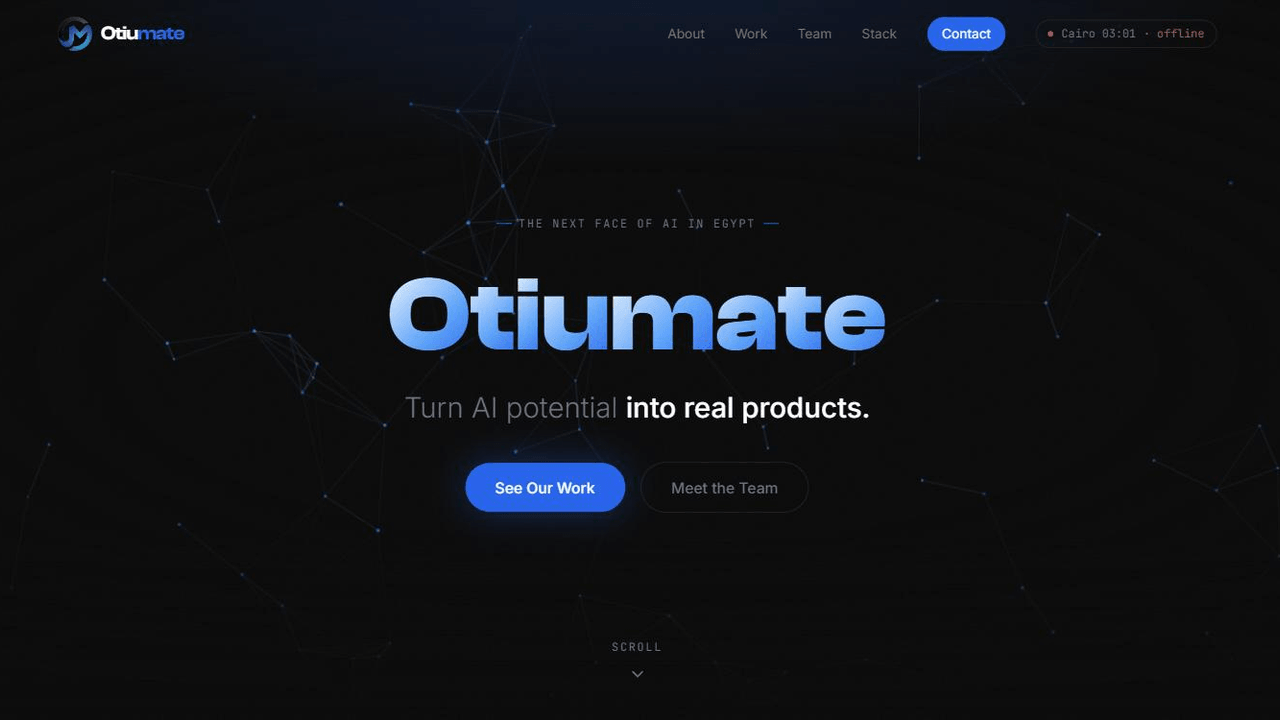
The hero sits on an animated constellation field, and the navbar carries a live Cairo clock with an online/offline indicator — small signals that a person is behind this. Framer Motion handles the section transitions. The whole thing is a static Vite build, so none of that costs a server.
Treat the deploy as part of the build
vercel.json sets security headers on every response — X-Frame-Options, X-Content-Type-Options, Referrer-Policy, XSS protection — and marks the hashed asset bundle immutable with a one-year cache. SPA rewrites send every route to index.html so deep links survive a refresh. Custom domain on Vercel, DNS included.
What it's built with
- Frontend
- React 18, TypeScript, Vite 5, Tailwind CSS v3 with custom CSS variables
- Motion
- Framer Motion 11 for section transitions, preloader and the constellation hero
- Content
- Typed data modules for team, projects, stack and testimonials — editable without touching components
- Infra
- Vercel with a custom domain, security headers and immutable asset caching configured in vercel.json
What I'd do differently
- The stat counters on the About section ship with em-dash placeholders instead of numbers. Better an honest blank than an invented figure, but it is a gap the design clearly expects to be filled, and it should have shipped with real numbers or a different layout.
- Content lives in typed files, which is ideal for me and still a barrier for a non-technical founder — editing a .ts file in GitHub is not the same as editing a page. A hosted CMS would have removed me from the loop entirely.
- There are no tests. For a marketing site that is a defensible trade, but the contact form is the one path where a silent failure costs real money, and that deserved coverage.